CERTIFIED FACILITIES • DATA DESTRUCTION • FREE DROP-OFF
E-Waste Recycling Near Me
Enter your ZIP code and we will send you the closest certified e-waste drop-off points and pickup options, including what each one accepts, what it charges, and how your data is handled.
- Free for most household electronics
- Certified data destruction available on request
- Pickup for bulk, office and business loads
Get your free drop-off list
Three details to start. We will send your nearest certified options within one business day.
Find E-Waste Recycling Near You
Electronics do not belong in a curbside bin. Most contain lead, mercury, lithium or brominated flame retardants that have to be separated under controlled conditions, and many still hold personal data long after you think it is gone. Enter your ZIP code and we will match you with the certified drop-off points and pickup options closest to you.
Enter a ZIP and we will send the certified drop-off points nearest you, with what each one accepts.
Where Can I Recycle Electronics Near Me?
Options vary by city, but nearly every area has at least one of these four. The closest one is not always the right one: a retail counter will take a laptop and turn away a CRT television.
Retail drop-off
- Big-box electronics chains
- Office supply stores
- Phone carrier counters
- Size and quantity limits apply
City and county sites
- Household hazardous waste days
- Permanent transfer stations
- Proof of residency sometimes needed
- Usually free, limited hours
Manufacturer take-back
- Prepaid mail-back programmes
- Trade-in credit for working gear
- Brand-specific and model-specific
- Best for small, light items
Certified recyclers
- R2 or e-Stewards facilities
- Accept almost every category
- Data destruction on request
- Pickup for bulk loads
What Counts as E-Waste?
E-waste is any discarded item with a plug, a battery or a circuit board. That covers more than most people expect: a printer is e-waste, and so is a cordless drill, an electric toothbrush, a smart doorbell and a pair of headphones.
The reason it is handled separately is what sits inside. One swollen laptop battery can start a fire in a compactor. A single CRT tube holds several pounds of leaded glass. Circuit boards carry gold, copper and palladium that are worth recovering, alongside cadmium and beryllium that should never reach groundwater.
- Anything with a power cord, plug or charging port
- Anything with a rechargeable pack or button cell inside
- Anything with a screen, a circuit board or stored memory
- Cables, chargers, adapters, remotes and peripherals
Electronics We Accept
If it plugs in, charges or stores data, it belongs in one of these five groups. Nothing has to be working, and nothing has to be complete.
Computers and laptops
Desktops, laptops, tablets, all-in-ones, thin clients, monitors, docking stations and keyboards. Hard drives are wiped or shredded and the serial numbers are logged.
TVs, monitors and displays
Flat panels, projectors, digital signage and older CRT sets. CRTs carry leaded glass, so a handful of sites charge a small handling fee. We tell you before you drive.
Phones, tablets and wearables
Smartphones, tablets, smartwatches, fitness bands, e-readers and cameras. Take out the SIM and memory card, factory reset, and we handle the rest.
Printers, office and networking
Printers, copiers, scanners, shredders, UPS units, routers, switches, servers, racks and desk phones, plus the toner and ink cartridges that came with them.
Small appliances and household electronics
Microwaves, vacuums, kettles, power tools, games consoles, speakers, remotes, cables and chargers. Anything with a cord or a battery has a route.
Find Recycling by Device Type
The right destination depends on what you are holding. Here is where each of the common ones goes, and what to do before you hand it over.
Laptop or desktop
Wipe it yourself or let us shred the drive and log the serial. Machines under about five years old often qualify for trade-in credit instead of scrap.
Television
Screen size and type decide the route. Flat panels are usually free; older CRT sets need a site licensed to handle leaded glass.
Phone or tablet
Carrier stores, manufacturer mail-back and certified recyclers all take them. Factory reset the device and remove the SIM and memory card first.
Printer or copier
Accepted almost everywhere. Take the toner or ink cartridge out first, because cartridge take-back is usually a separate programme.
Batteries
Never the trash. Lithium-ion packs, button cells and sealed lead-acid each have their own collection point, and terminals should be taped.
Cables and chargers
Bundle them into one bag. The copper inside is worth recovering, and loose cables tangle and jam mechanical sorting lines.
Bulk or heavy loads
A server rack, an office refresh, a decade of storeroom clutter: book a single pickup instead of making six trips in a car.
The Batteries Inside Your Electronics
Most fires at recycling facilities start with a battery that was never supposed to be there. Lithium-ion cells puncture easily, and a punctured cell inside a compactor is an ignition source rather than a recycling problem. This is the single most important thing to get right before you drop anything off.
If the battery slides out without tools, take it out and bring it to a battery collection point. If it is glued, clipped or soldered in place, as in a phone, a laptop or a wireless earbud, leave it where it is and tell the recycler the battery is still inside. It goes through a different, slower process built for exactly that.
- Tape the terminals on loose lithium and button cells
- Never place any battery in a curbside or household trash bin
- Bag swollen, leaking or damaged cells separately and point them out
- Leave sealed-in batteries alone rather than prying them free
Your Data Leaves With the Drive
Deleting files and emptying the recycle bin does not remove the data. It removes the pointer to it, and the contents can sometimes still be recovered with ordinary tools. A factory reset is much stronger, and on a modern encrypted phone or laptop it is usually enough, because the reset throws away the encryption key and leaves everything behind it unreadable. Older spinning hard drives have no key to discard, so they need overwriting or physical destruction to be genuinely clean.
If a drive held anything you would not hand to a stranger, such as tax records, client files, saved passwords or family photos, ask for the wipe in writing. Certified destruction comes with a serial-numbered report you can file, which matters if anyone ever asks you to prove it.
- Sign out of accounts and de-authorise the device first
- Factory reset phones, tablets and encrypted laptops before handover
- Ask for an overwrite or shredding on older spinning hard drives
- Keep the certificate of destruction with your records
How to Prepare Your Electronics
Five minutes of preparation decides whether your data is safe and whether the load is accepted on arrival.
1. Back up, then wipe
Copy off anything you want to keep, sign out of your accounts and de-authorise the device, then factory reset it or ask us to wipe and log the drive.
2. Separate and tape
Pull out any battery that comes free and tape its terminals. Take toner and ink cartridges out of printers. Bundle cables and chargers into one bag.
3. Drop off or book a pickup
Bring it to the nearest certified site during opening hours, or book a collection if the load is heavier than one car trip.
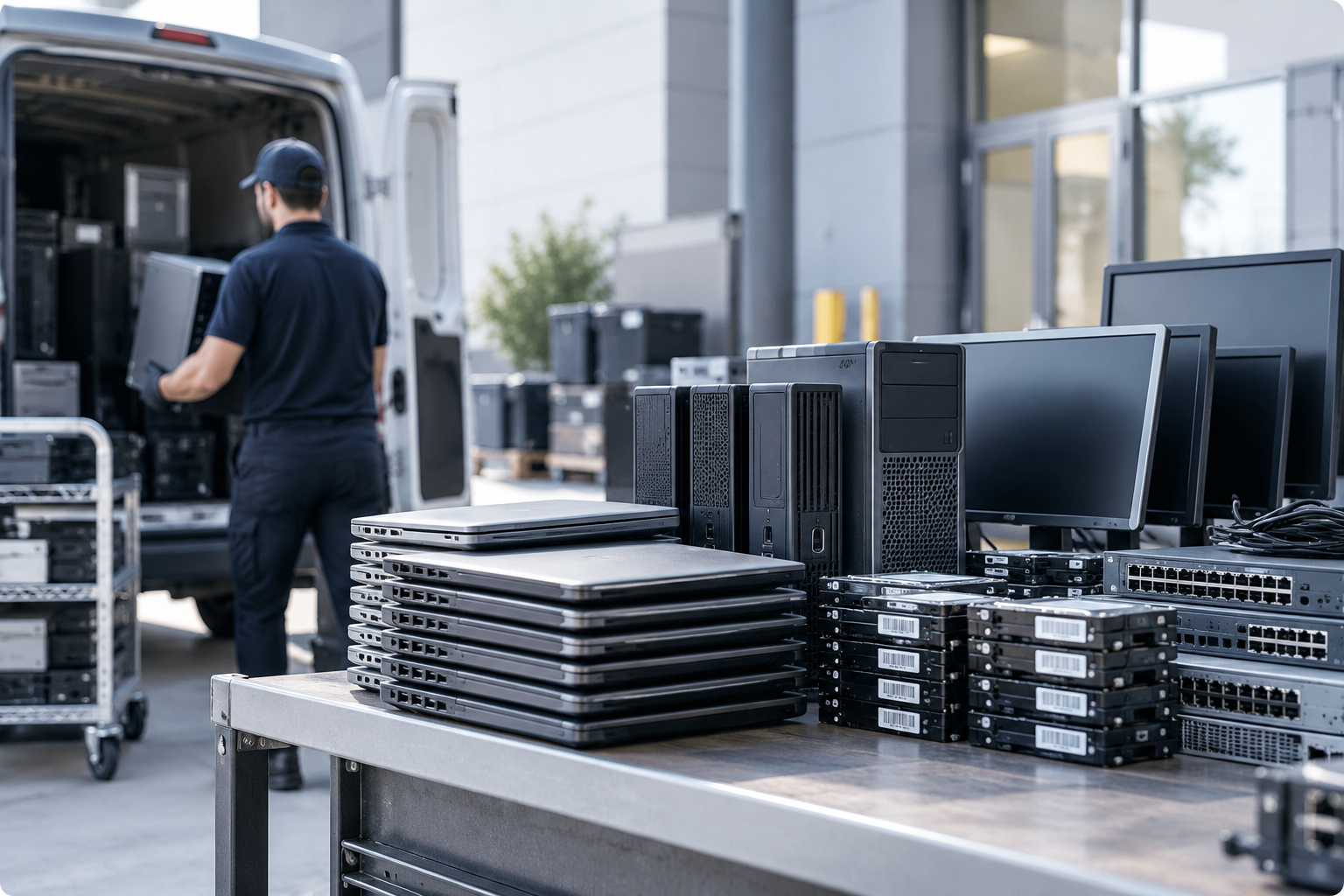
Bulk and Business Collections
A retired server rack, thirty end-of-lease laptops, a classroom refresh, a storeroom that has been filling up for a decade. These need a scheduled collection, an asset list and paperwork an auditor will accept, not a trip to a drop-off bin.
- Scheduled pickup at your dock, office or site
- Serial-numbered asset inventory before anything leaves
- Drive destruction on site or at the facility, your choice
- Certificate of recycling and destruction for every job
- R2 or e-Stewards certified downstream processing
- Rebate offered where equipment still holds resale value
E-Waste Recycling Questions, Answered
For most household electronics, yes. Municipal collection events and certified recyclers usually take computers, phones, printers and small appliances at no charge, because the recovered metals cover the handling cost. The common exception is CRT televisions and monitors, where leaded glass costs more to process than it returns, so expect a small per-unit fee. We tell you which applies before you drive anywhere.
Book a pickup. Large flat panels and old CRT sets are the most common reason people call instead of driving, and a scheduled collection usually costs less than renting a van. Tell us the screen size and whether it is a flat panel or a tube so the right vehicle and the right site are lined up.
Yes, if you ask for it. Factory reset whatever you can before handing anything over, and for drives that held sensitive records request certified destruction: the drive is overwritten to standard or physically shredded, and you receive a serial-numbered certificate. Treat data destruction as a service you request, not something to assume.
No. Curbside bins are sorted by machines built for paper, glass and plastic, and electronics damage that equipment. Batteries are the bigger hazard: a lithium cell that gets crushed in a collection truck can ignite. Every area we cover keeps e-waste on a separate stream for exactly this reason.
Yes, and nothing has to work. A dead laptop, a cracked tablet, a printer that jammed for the last time: the materials inside are still recoverable. Mention anything that does still work, though, because it may be refurbished or resold and earn you a credit instead of being scrapped.
Ready to clear it out?
Enter your ZIP and we will send the nearest certified drop-off points, what each one accepts, and pickup options for anything too big to carry.
Certified e-waste recycling, drop-off matching and bulk collections. Data destruction on request, with paperwork you can file.
- Household drop-off matching
- Bulk and office collections
- Hard drive destruction
- Battery and CRT handling
© 2026 ewasterecyclingnearme.com — All rights reserved.